
Constructing a modern hyperscale data center to support today’s demanding AI and high-performance computing (HPC) workloads is an undertaking of colossal scale. These facilities, the very foundations of the AI Factory, must be engineered not just for reliability, but for unprecedented power density.
To grasp the sheer size, consider a 200 MW data center campus. This single site requires material volumes equivalent to constructing major infrastructure projects: thousands of tons of structural steel for the frame and countless cubic yards of reinforced concrete for foundations and fire-rated structures. In this post, we’ll walk through the process of constructing such a facility from the ground up, the materials that go into it, and the multi-phase process that guides it from concept to commissioning.
1. Structural Requirements: Building for the Byte
The physical structure of an AI data center is fundamentally different from a standard office building. It must be a mission-critical fortress designed for high density and continuous operation.
A Foundation of Steel and Concrete
While reinforced concrete is essential for foundational stability and thermal mass, modern data center construction heavily favors structural steel for the frame, especially in areas supporting IT equipment.
- Heavy Floor Loads: AI servers and liquid cooling distribution units impose significantly heavier loads than traditional IT equipment. The structure must support heavy floor loads, requiring deep beams and high-strength concrete slabs or specialized steel decking.
- Resilience: The facility must be designed for resilience, meaning it must be earthquake-proof (often using lighter, more flexible steel frames in seismic zones) and utilize fire-resistant materials throughout the structure and in all internal partitions.
- Scale of Materials: While the exact quantity varies wildly based on design and location, the amount of steel and reinforced concrete required is massive. The industry continually refines designs to optimize for material usage, moving towards hybrid steel-and-concrete systems that balance the speed of steel construction with the density and fire protection of concrete.
The Builders of the AI Factory
Building these complex facilities requires specialized expertise. A few firms dominate the mission-critical construction space due to their experience in fast-track delivery and complex mechanical/electrical systems installation. Among the top builders and construction companies that work with data center providers are:
- DPR Construction
- Turner Construction Company
- AECOM (often providing engineering and construction management)
- Holder Construction Company
2. Build vs. Buy: The Rise of Modular Deployment
For high-speed deployments or standardized designs, operators can “buy” rather than “build” core infrastructure through prefabricated solutions.
Prefabricated Modular Units involve manufacturing standardized, tested, and assembled components, such as power distribution units (PDUs), cooling systems (chillers or pumps), or even entire data halls, off-site in a factory setting. This speeds up construction time, improves quality control, and is highly scalable.
A handful of vendors that offer prefabricated and modular solutions include:
- Schneider Electric, Vertiv, ABB, and Dell Technologies
3. The Data Center Construction Process: A Phased Approach
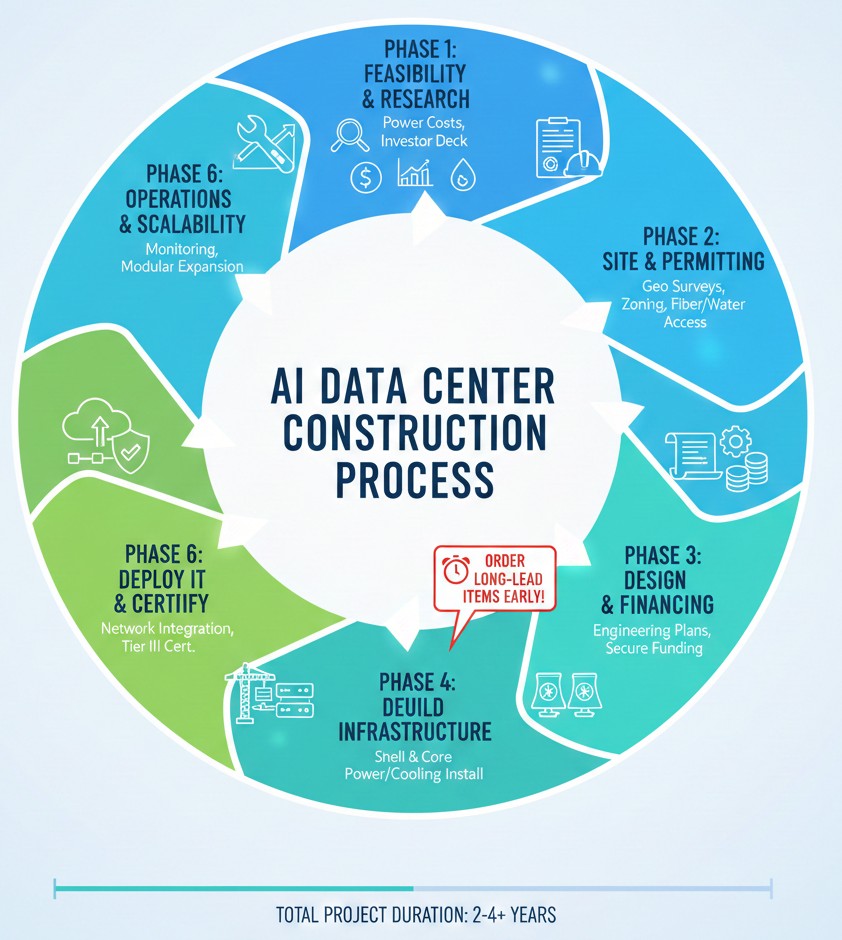
Constructing a multi-hundred-megawatt AI Factory is a long-haul journey. Success hinges on rigorous planning, early procurement, and proactive community engagement. It is critical to order long-lead items (such as high-voltage switchgear, massive generators, and high-capacity transformers) as early as possible in the process, as their procurement timelines can exceed the duration of Phase 4 construction. Engaging local communities early is also essential to navigating local approvals, zoning, and rights to connect to infrastructure.
The construction process typically follows these defined phases:
| Phase | Duration Estimate | Key Activities and Focus |
| Phase 1: Market Research & Feasibility | 3 Months | Analyze local demand, evaluate total cost of ownership (TCO) across potential regions, focusing heavily on power costs, and assess competitor pricing. Conclude with a detailed feasibility study and investor deck. |
| Phase 2: Site Acquisition & Permitting | 6–9 Months (Permitting up to 18 Months) | Secure the land, conduct geotechnical surveys and environmental impact assessments, and confirm access to necessary utilities (fiber, water, high-voltage power). Navigate local zoning and permits to de-risk the project for future investors and lenders. |
| Phase 3: Design, Engineering & Financing | 6 Months | Produce construction-ready plans for the architectural design and the complex electrical and mechanical systems. Secure the full funding package via developer equity, debt, and potential government grants or incentives. |
| Phase 4: Shell, Core, Power & Cooling Infrastructure | 16–30 Months | The physical build: erect the building shell and core. Install critical infrastructure using specialized contractors, including switchgear, high-capacity UPS systems, diesel or natural gas generators, and advanced chillers and piping for cooling systems. |
| Phase 5: Deploy IT & Commissioning | 3–6 Months | Tenant fit-out of the white space. Integrate network infrastructure, install racks and servers, and conduct rigorous testing. Achieve final facility certifications, such as Tier III or Tier IV compliance. |
| Phase 6: Operations & Scalability | Ongoing | Begin full commercial operations. Focus on efficiency, maintenance, and planned expansion. Ensure the facility’s modular design allows for future growth and seamless scalability without disruption. |
Building an AI Factory is not merely putting up a building; it is the precise and coordinated installation of immense, interlocked mechanical and electrical systems designed for zero downtime. This monumental effort requires specialized contractors, massive material logistics, and a commitment to integrating resilience at every level, from the concrete foundation to the final electrical switchgear.
The construction process is a critical foundation for the AI workloads to come, ensuring that the facility is not just operational, but optimized for high density, liquid cooling demands, and rapid scalability. Successfully executing this multi-year, multi-phase project is the first step in creating the physical infrastructure that will power the next generation of artificial intelligence.