
What keeps the executives at OpenAI, NVIDIA, CoreWeave, and Google up at night? They represent four distinct industries, but they share a singular, fragile dependency: scarcity-based economics. While revenues are at all-time highs, there are no guarantees that a massive geopolitical shift won’t turn their business models into relics overnight.
For the Western C-suite, the ghost in the machine is China.
To many in the West, China remains a black box. In reality, it is a box filled with the ingredients of a global disruptor: the world’s largest GDP by Purchasing Power Parity ($40.7 trillion vs the US’s $30.5 trillion in 2025), a stranglehold on the minerals required for high-tech manufacturing, and an “army” of STEM talent. By the end of 2025, China is projected to graduate 77,000 STEM PhDs annually, nearly double the 40,000 expected in the United States.
The industry felt the first tremor with DeepSeek. It was a staggering body blow that proved China could achieve frontier-level AI performance at a fraction of the traditional Western cost. This was followed by their semiconductor “Manhattan Project,” a state-led mobilization aimed at cracking Extreme Ultraviolet (EUV) lithography. Functional prototypes emerged in late 2025, signaling that China is no longer just chasing ASML; they are building a bypass.
The Play: Turning “Dynasties” into “Second-Tier”
If China wanted to deliver a lethal blow to the US AI industry, they wouldn’t just try to build a better chip; they would build a cheaper one. They have the power to turn the US tech giants, currently the “Super Bowl Mahomes-led Chiefs” of the global economy, into a second-tier team that doesn’t even make the playoffs by 2031.
The play is simple but devastating: The $1,000 High-End GPU.
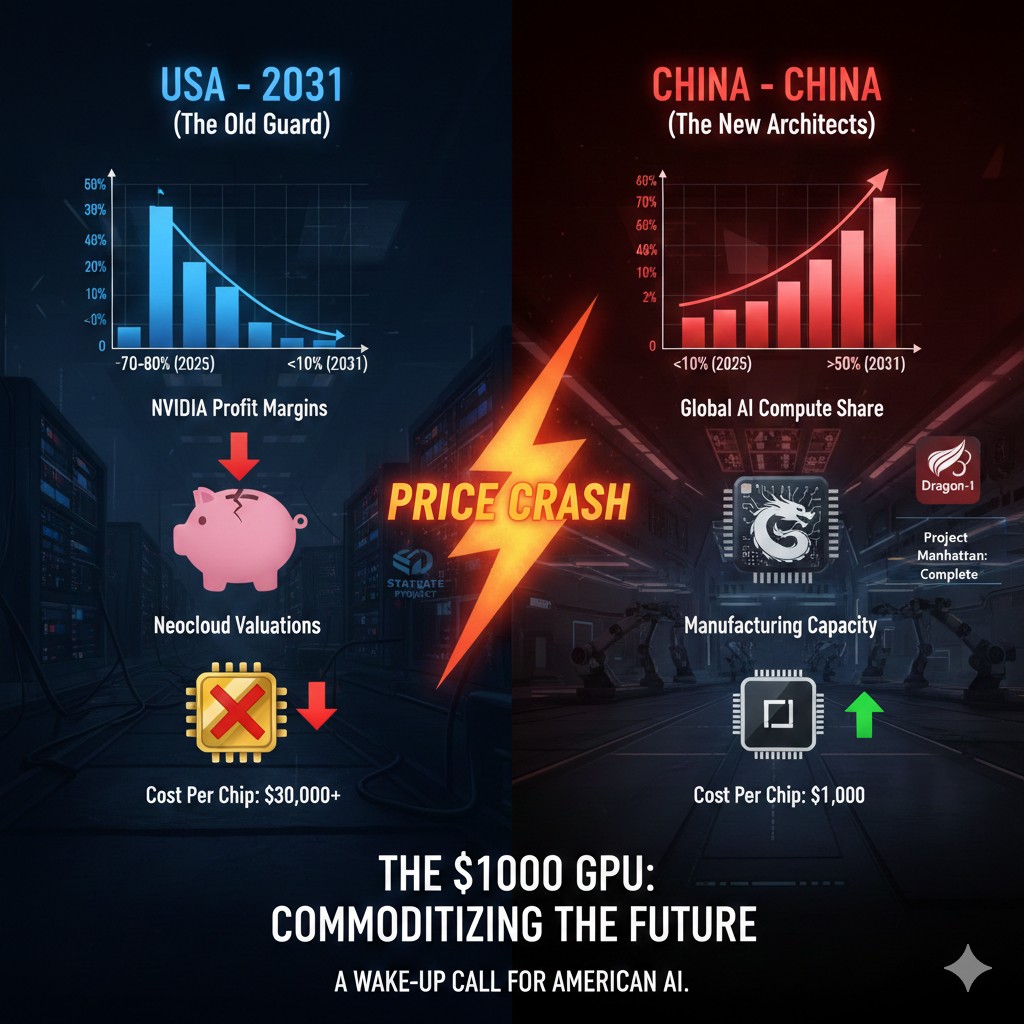
Imagine it is 2031. China introduces the “Dragon-1,” a high-end GPU that matches the performance of an NVIDIA GB300-equivalent but retails for exactly $1,000. While NVIDIA and the Stargate Project are currently locked into a business model where a single chip costs $30,000 to $40,000, China introduces a commodity equivalent that fundamentally breaks Western economics.
The Ramifications: A Total Financial Reset
The fallout of a $1,000 high-end GPU would be total:
- NVIDIA’s Margin Collapse: The 73% gross margins that fueled NVIDIA’s $4 trillion rise would evaporate. When “gold” becomes as common as “copper,” the miner loses all leverage.
- The Neocloud Debt Trap: Companies like CoreWeave have secured billions in debt collateralized by the value of their GPU fleets. If a $1,000 chip can do the work of a $30,000 chip, the collateral on their balance sheets effectively vanishes, triggering a debt crisis.
- The End of High-Rent Compute: Google and Microsoft would no longer be able to charge a premium for AI access. Tokens would become so cheap that “cost per million” would cease to be a relevant metric.
Will We Miss the Boat
Western tech leaders have spent years focused on sovereign AI and supply chain security, but they are ignoring the oldest play in the Chinese handbook: the cost curve. China doesn’t need to win a race for “the most powerful chip ever made.” They only need to produce a “good enough” chip at a price point that makes the Western business model obsolete.
China could tank the US AI infrastructure industry while being heralded as a global savior for “democratizing” compute for the masses. When the $1,000 GPU arrives, the era of “AI as a Luxury” ends. The only question left for the West is: will we be the ones who lead the transition, or the ones who are buried by it?
The US is playing chess. China is playing Go. Go figure.